Buy belgaweb.be ?
We are moving the project
belgaweb.be .
Are you interested in purchasing the domain
belgaweb.be ?
domain@kv-gmbh.de · 0541-91531010
Buy belgaweb.be ?
'N or n-sample in statistics?'
In statistics, an N-sample refers to a sample size of N, where N represents the number of individual observations or data points in the sample. The letter N is often used to denote the size of a sample in statistical analysis. It is important to have a sufficiently large sample size (N) to ensure the reliability and validity of statistical results. A larger sample size generally leads to more accurate and precise estimates of population parameters. **
What is the definition of the sets n x n and n x n x n for the set of natural numbers n? Please visualize these sets.
The set n x n is the Cartesian product of the set of natural numbers with itself, resulting in a set of ordered pairs of natural numbers. For example, if n = 3, then n x n = {(1,1), (1,2), (1,3), (2,1), (2,2), (2,3), (3,1), (3,2), (3,3)}. This can be visualized as a grid with rows and columns of natural numbers. The set n x n x n is the Cartesian product of the set of natural numbers with itself three times, resulting in a set of ordered triples of natural numbers. For example, if n = 2, then n x n x n = {(1,1,1), (1,1,2), (1,2,1), (1,2,2), (2,1,1), (2,1,2), (2,2, **

Similar search terms for N
Top-Angebote
Products related to N:




-
Can you show that this mapping is a bijection: n x n -> n^m * 2^n+1 - 1?
To show that the mapping n x n -> n^m * 2^n+1 - 1 is a bijection, we need to demonstrate that it is both injective and surjective. To show injectivity, we need to prove that distinct elements in the domain map to distinct elements in the codomain. This can be done by showing that if (a, b) and (c, d) are distinct pairs in n x n, then n^m * 2^a+1 - 1 and n^m * 2^c+1 - 1 are distinct in n^m * 2^n+1 - 1. To show surjectivity, we need to prove that every element in the codomain has a pre-image in the domain. This can be done by showing that for every element in n^m * 2^n+1 - 1, there exists a pair (a, b) in n x n such that **
-
Are the sets N and N of equal power?
Yes, the sets N and N are of equal power. Both sets represent the set of natural numbers, which includes all positive integers starting from 1. Since both sets have the same elements and there is a one-to-one correspondence between them (each natural number in N corresponds to the same natural number in N), they are considered to have the same cardinality or power. **
-
What is the limit of n * sqrt(n+71)?
The limit of n * sqrt(n+71) as n approaches infinity is infinity. This can be seen by considering the behavior of the function as n becomes very large. As n increases, the value of n * sqrt(n+71) also increases without bound, as the square root term dominates the behavior of the function. Therefore, the limit of n * sqrt(n+71) as n approaches infinity is infinity. **
-
Is a mapping from n to n not equinumerous, but countable? And would a mapping from n to n be countable if n were natural numbers without zero?
A mapping from n to n is equinumerous and countable because it is a one-to-one correspondence between the natural numbers. If n were natural numbers without zero, a mapping from n to n would still be countable because it would still be a one-to-one correspondence between the natural numbers. In both cases, the mapping is countable because it can be put into a one-to-one correspondence with the set of natural numbers. **


How do you eliminate n^2, 2n, n, and 6?
To eliminate n^2, 2n, n, and 6, you can factor out the common factor, which is n, from each term. This will leave you with n(n + 2 + 1 + 6/n). **
What is the convergence of sqrt(n^2 + 1)/n?
The convergence of the sequence sqrt(n^2 + 1)/n is 1. This can be seen by taking the limit as n approaches infinity. As n becomes very large, the n^2 term dominates the 1 term inside the square root, and the expression becomes approximately sqrt(n^2)/n, which simplifies to n/n = 1. Therefore, the sequence converges to 1 as n goes to infinity. **
Top-Angebote
Products related to N:
-
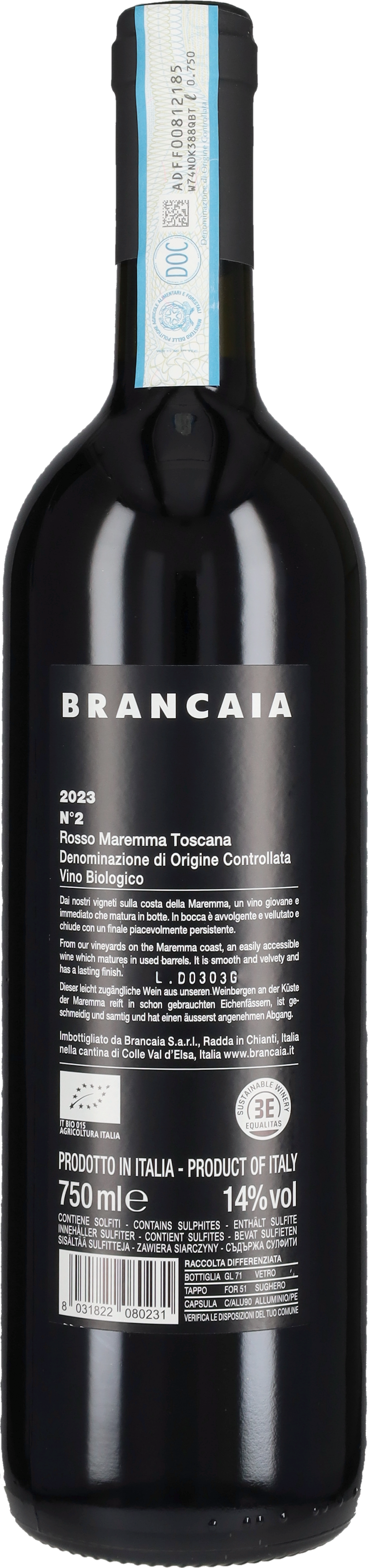
Cabernet Sauvignon 'N°2' Brancaia 2023De Cabernet Sauvignon "Nummer 2" van Brancaia is een rode wijn die de bijzondere kenmerken van het prachtige en zonnige gebied van de Toscaanse kust goed tot uitdrukking brengt en zijn roeping voor de teelt van de nobele Bordeaux-druiven. In het bijzonder geeft de Cabernet Sauvignon wijnen met een goede structuur, warm, omhullend, aromatisch complex en geurend. De rijping in tonneau is nooit opdringerig en de wijn behoudt de charme van het variëteitboeket, met aroma's van rode vruchten, delicate specerijen en tonen van mediterraan struikgewas. De "N2" Brancaia komt uit het landgoed in de Toscaanse Maremma, van Cabernet Sauvignon-wijngaarden die zijn aangeplant in percelen met zonnige west- en zuidwestexposities. De wijnstokken wortelen in hoogwaardige bodems die bestaan uit leem en klei, met een sterke aanwezigheid van grind en stenen, waardoor ze bijzonder goed doorlatend zijn. Het warme en mediterrane klimaat, gematigd door de bries van de Tyrreense Zee en met aanzienlijke temperatuurverschillen, zorgt voor rijpe en rijke druiven. De oogst vindt meestal plaats tegen het einde van september en de druiven worden gefermenteerd bij een gecontroleerde temperatuur van 28°C met een schilweking van 18 dagen. De wijn rijpt in 500 liter tonneaux van tweede gebruik gedurende 12 maanden en voltooit de rijping met enkele maanden in de fles voordat hij te koop wordt aangeboden. De wijn Cabernet Sauvignon Brancaia is een rode wijn die bevestigt hoe internationale druivensoorten, en in het bijzonder de Bordeaux-druiven, een tweede thuis hebben gevonden in het milde en zonnige klimaat van de Toscaanse kust. Dankzij de rijping in reeds gebruikte tonneaux weet de wijn een goede balans te vinden tussen de fruitige tonen van jeugd en elegante, delicate evolutionaire aroma's, nooit gedreven naar een overmatige tertiarisering. In het glas heeft hij een intense robijnrode kleur. In de neus komen de typische aroma's van kleine bessen, ondergroei, kruiden, specerijen en vanille naar voren. De smaak behoudt een levendige fruitige frisheid, die zich opent naar een goede aromatische complexiteit, met een geëvolueerde tanninestructuur en een aangename finale frisheid.21,50 €*Shipping: 25,00 €Secure redirect to the provider
-
'N or n-sample in statistics?'
In statistics, an N-sample refers to a sample size of N, where N represents the number of individual observations or data points in the sample. The letter N is often used to denote the size of a sample in statistical analysis. It is important to have a sufficiently large sample size (N) to ensure the reliability and validity of statistical results. A larger sample size generally leads to more accurate and precise estimates of population parameters. **
-
What is the definition of the sets n x n and n x n x n for the set of natural numbers n? Please visualize these sets.
The set n x n is the Cartesian product of the set of natural numbers with itself, resulting in a set of ordered pairs of natural numbers. For example, if n = 3, then n x n = {(1,1), (1,2), (1,3), (2,1), (2,2), (2,3), (3,1), (3,2), (3,3)}. This can be visualized as a grid with rows and columns of natural numbers. The set n x n x n is the Cartesian product of the set of natural numbers with itself three times, resulting in a set of ordered triples of natural numbers. For example, if n = 2, then n x n x n = {(1,1,1), (1,1,2), (1,2,1), (1,2,2), (2,1,1), (2,1,2), (2,2, **
-
Can you show that this mapping is a bijection: n x n -> n^m * 2^n+1 - 1?
To show that the mapping n x n -> n^m * 2^n+1 - 1 is a bijection, we need to demonstrate that it is both injective and surjective. To show injectivity, we need to prove that distinct elements in the domain map to distinct elements in the codomain. This can be done by showing that if (a, b) and (c, d) are distinct pairs in n x n, then n^m * 2^a+1 - 1 and n^m * 2^c+1 - 1 are distinct in n^m * 2^n+1 - 1. To show surjectivity, we need to prove that every element in the codomain has a pre-image in the domain. This can be done by showing that for every element in n^m * 2^n+1 - 1, there exists a pair (a, b) in n x n such that **
-
Are the sets N and N of equal power?
Yes, the sets N and N are of equal power. Both sets represent the set of natural numbers, which includes all positive integers starting from 1. Since both sets have the same elements and there is a one-to-one correspondence between them (each natural number in N corresponds to the same natural number in N), they are considered to have the same cardinality or power. **
Similar search terms for N
-
What is the limit of n * sqrt(n+71)?
The limit of n * sqrt(n+71) as n approaches infinity is infinity. This can be seen by considering the behavior of the function as n becomes very large. As n increases, the value of n * sqrt(n+71) also increases without bound, as the square root term dominates the behavior of the function. Therefore, the limit of n * sqrt(n+71) as n approaches infinity is infinity. **
-
Is a mapping from n to n not equinumerous, but countable? And would a mapping from n to n be countable if n were natural numbers without zero?
A mapping from n to n is equinumerous and countable because it is a one-to-one correspondence between the natural numbers. If n were natural numbers without zero, a mapping from n to n would still be countable because it would still be a one-to-one correspondence between the natural numbers. In both cases, the mapping is countable because it can be put into a one-to-one correspondence with the set of natural numbers. **
-
How do you eliminate n^2, 2n, n, and 6?
To eliminate n^2, 2n, n, and 6, you can factor out the common factor, which is n, from each term. This will leave you with n(n + 2 + 1 + 6/n). **
-
What is the convergence of sqrt(n^2 + 1)/n?
The convergence of the sequence sqrt(n^2 + 1)/n is 1. This can be seen by taking the limit as n approaches infinity. As n becomes very large, the n^2 term dominates the 1 term inside the square root, and the expression becomes approximately sqrt(n^2)/n, which simplifies to n/n = 1. Therefore, the sequence converges to 1 as n goes to infinity. **
* All prices are inclusive of VAT and, if applicable, plus shipping costs. The offer information is based on the details provided by the respective shop and is updated through automated processes. Real-time updates do not occur, so deviations can occur in individual cases. ** Note: Parts of this content were created by AI.